
Co-authored by Anne-Marie Martindale & Jacob Astley
The recent killings perpetrated by a young man, Jake Davison, in Plymouth in the UK - first of his mother and then of four strangers - have drawn attention once more to an internet organisation calling themselves ‘Incels’. This group of ‘involuntarily celibate’ men - which Davison was believed to be affiliated with - espouse sexist ideology and openly promote misogyny. Incel-related misogynistic driven violence is not a new phenomenon. The recent incident in the UK, however, hastens the need not only to recognise it but, moreover, to address the dangerous reality of Incel culture.
The nascent debate that the Plymouth attack generated was rapidly overshadowed by events in Afghanistan. There, ISIS-Khorosan (ISIS-K) - targeting those trying to flee the country at Kabul airport - killed over 175 people and injured many more, detonating an explosive device at the entrance to the airport. In contrast to the incident in Plymouth, the attack at Kabul airport was immediately ascribed as an act of terrorism by security experts and understood as such in the media and political circles. Although there was some debate about the drivers for the Plymouth perpetrator - most notably stimulated by the comments made by Jonathan Hall, QC, the UK Government’s Independent Reviewer of Terrorism - the attacks in Plymouth were not defined as terroristic.
In observing the growing presence of misogynistic online groups, Incels appear to meet traditional criteria used to define terrorist organisations.
Given that - on the surface at least - it would seem that both the violent attacks in Afghanistan and Plymouth were motivated by ingrained values and beliefs that can be defined as ‘extremist’. This raises some interesting questions. Should those inspired to undertake acts of violence by Incel culture be considered terrorists? Indeed, should the Incel network itself be classified as a terrorist organisation?
In observing the growing presence of misogynistic online groups, Incels appear to meet traditional criteria used to define terrorist organisations. After all, members of the extreme Incel culture share an ideology, form part of a horizontal global network of individuals with dangerous views and provoke subscribers to undertake indiscriminate violence against women. Yet, with no clear guidelines on what constitutes a terrorist organisation and what does not, Incels continue to slip the net.
The merging and blurring of online and offline realms is part of a broader picture that can be associated with the tragedy in Plymouth.The speed, scope and scale of the internet affords opportunities for those that incite violence and presents sizeable challenges for those trying to prevent it. The evolving nature of the online realm, its widespread accessibility and the possibility of anonymity are factors which Incels - like terrorists - seek to exploit to propagate hate and violence.
The attacks in Plymouth were certainly not the first nor the only act of organised and extreme violence perpetrated by individuals affiliating with this group. Demonstrable connections have been made with similar acts of violence in Canada and the United States in recent years. Yet still, as a group, Incels are not formally recognised as a terrorist organisation. It could be that reluctance to recognise them as such lies in their ideology which is rooted in hatred against women, or indeed psychosocial circumstances that affect young men who may already be socially vulnerable in different ways.
In recent years, criminological researchers have been paying increasing attention to the links to be found between men who abuse women and their tendencies toward political and religiously motivated violence. The work of Joan Smith (2019) is the most recent in a long history of feminist informed work which has made these links explicit. From the intervention of Frances Power Cobbe in 1879 - who labelled wife abuse as torture - to Morgan’s powerful observations in The Demon Lover first published in 1989 and updated post 9/11, 2001, to Elizabeth Stanko’s (1997) analysis of women’s fear of crime as a technology of the soul, alongside the work of Johnson (1995) defining domestic abuse as intimate terrorism, to the work of McCulloch et al (2019) on so-called ‘lone-wolf’ terrorism.
The merging and blurring of online and offline realms is part of a broader picture that can be associated with the tragedy in Plymouth.
Taken together, this work demonstrates the links between misogyny and the lives women live in a culture of fear and intimidation by men; some of which result in death at the hands of those same men, like in Plymouth, where one of the victims was the young man’s mother. To put it simply, neither Incels nor other terrorist organisations - like ISIS-K - assign much value to women’s lives outside of their presence in the world to service and support men, raising the question as to why women’s safety and security is not only muted but routinely ignored.
So when is a terrorist organisation not considered terroristic? Why is an ideology that only targets women and supports indiscriminate hatred and violence against them beyond the reach of terrorism? What might be the resourcing implications of classifying Incels as terrorists? Might bringing this group more squarely under the purview of the security and intelligence service attention result in greater protection for women at risk?
Food for thought indeed for those wanting to understand terrorism and those for whom it has serious consequences. How to prevent those consequences for those subjected to its worst effects should be a priority for researchers, politicians, policy makers and security practitioners.
How is a Horizon 2020 project conducted? Who are the professionals working on DRIVE and which perspectives do they bring to the project? In this series of interviews, you will get to meet the team members of DRIVE and learn more about their areas of expertise and the role they play throughout the course of the project.
This first Meet The Team interview features Prof. Tahir Abbas, the scientific coordinator of DRIVE.

"Extremism and radicalisation, in my mind, are less about religion and more about politics, economics, and society."
I have been looking at issues of violent extremism for two decades. The events of 9/11 spurred me on to try to explore some of these issues in more detail, especially as before this tragic day, several related concerns were going on in the city of Birmingham that made me think twice about what was happening to young Muslims concerning identity, ideas of belonging, and issues to do with the violence that was being forged into a heady mix with significant implications.
I know several colleagues who had got into this field because of some direct and indirect experience related to extremism and radicalisation, whether it was a close friend who was routinely subjected to harassment by the police or somebody they knew at school who found themselves implicated in some plot later in life. People like me, who are born in a country different to that of our parents, are habitually challenged by questions of identity and belonging. Some of us can reconcile these issues while others can see it transformed into something far more problematic.
Extremism and radicalisation, in my mind, are less about religion and more about politics, economics, and society. Having spent many years before the events of 9/11 exploring race relations, the understandings I was able to figure out in terms of minority experiences and the implications this had for a sense of engagement and participation is no different from some of the genuine existential problems that young people face when trying to work out their paths in life per se. But a lot of this analysis is a million miles away from the programmatic approach taken by state-centric-led initiatives concerning countering violent extremism that continues to deemphasise the bottom-up, community-oriented issues related to extremism, which are more about social exclusion than anything else.
The Drive project is a unique opportunity to bring together social scientists and public mental health experts for the first time to explore some of the most challenging concerns facing societies in northwest Europe today. We understand that there is much that has already been written and expressed concerning questions of extremism, with a lot of it being polemical and often without any empirical support. Ours is a systematic attempt to try to enhance our understanding of radicalisation through exploring the wider issues of social exclusion in northwest Europe in a way that could not have been possible until recently.
Until recently, the far-right, alt-right and incels were not on the radar of policymakers. With a range of counter-competing and in some cases reciprocal radicalisation becoming the norm, the Drive project uniquely allows the project team to explore the synergies between diverse kinds of radicalisation based on an understanding of local area experiences. In this regard, we are interested in identity politics, intergenerational change, the idea of space and belonging associated with it, and the complex generalisable relationship between the extremism put forward by elements of the far right and the extremism put forward by elements of Jihadis because both sets of outcomes are not independent of the same social structural factors. Both sets of groups are looking for something beyond their own experience to buy in to, to believe in, and to support. In some cases, by whatever means necessary.
Having looked at this question for the last twenty years, the most important point is the issue of belonging. Unless young people have a sense of belonging, they do not have a sense of purpose. By not having a sense of purpose, they are easily distracted and persuaded, especially if they are young and impressionable. And then they face issues of being stuck in an echo chamber of negativity that becomes an added risk factor.
It is from these situations that we find the young people making the analytical and conceptual leap from holding frustrated grievances to enacting solutions to their problems through violence. While society considers their acts of violence as the problem, for the young people implicated, their actions are the solution. What compounds a lot of this is the unidirectional thinking on the part of states and supranational bodies which adhere to a top-down agenda based on the idea that the problem is inherited within a particular faith and the ideal would be to get to a vulnerable individual before radicalisation is operationalised from within.
All this does is enhance and legitimise Islamophobia, in the case of Islamist groups, but it also takes attention away from the genuine everyday realities that face so many people who end up with violent extremism as their solution. The need to understanding the social exclusion dynamic in radicalisation studies is to build solutions that are about looking at society, and not distinguishing these radicals as somehow separate us from the rest of us. They are remarkably like the rest of us but different enough to warrant paying further attention to their particular needs and wants.
The main critique I have of the current counter violent extremism paradigm is that it reproduces Islamophobia. All the tension among groups and individuals that somehow have gone wrong are seen as being due to some internal issues that are unresolvable and that these can be defined as being a result of interpretations of religion and practice. From all of the extensive research, practice and practitioner-oriented experiences, we realise that radicalisation is often an outcome based on everyday social processes.
In parts of the global south, we have instances of not just underdevelopment, inequity, and tribalism but also corruption, cronyism, and militarism and in some cases people who end up being radicalised because it is a form of employment. The far right targets unemployed and impressionable young men and offers them employment opportunities. Many who went from various parts of North Africa to what was the Islamic State did so because they were being offered paid employment, something that was difficult to sustain in places like Tunisia especially, after the events of the Arab Spring.
Overall, we need to take attention away from the fact that radicalisation is akin to someone’s faith somehow going wrong and see it more in the round. Rather, that radicalisation is a concept which aims to elaborate on what tips individuals from various stages of being radicalised and that these are much more about wider societal experiences rather than the more wicked end of the problem that policymakers tend to fixate on due to the urgency of what is seen as the problem and the need to provide solutions in quick response.
.
Contestations around Islam in Europe often take on specific spatial forms: right-wing groups protest the construction of mosques, legislators restrict the wearing of Islamic face coverings in public buildings, and politicians declare certain geographical areas such as the Parisian banlieues to be the battleground where the future of Europe will be decided.
This shows that the place of Islam in Europe, in both a metaphorical and a material sense, is deeply contested. However, does attention to moral panics around visible Islam in Europe provide us with an adequate understanding of how Muslims move through streets, shops and buildings? How can we understand the complex entanglement of Muslim and non-Muslims in Europe’s built environment, and what does that tell us about the idea of “inclusion”?
The way we identify what counts as “Islamic” or “Muslim”, a person, a place, a building, is deeply shaped by what we think a particular religion should look like. We often think about religious buildings such as mosques, religious dress such as hijab and religion allegedly overstepping the boundaries of its rightful place in the secular political order.
This distribution of attention is prone to neglect forms of being Muslim in Europe that have material effects in other, often unexpected ways. For instance, consider the following picture.
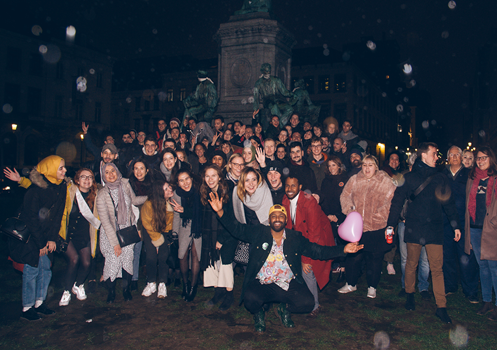
If you look at the picture, what is your first impression? Does it show Muslims in a way they are usually portrayed in media presentations and political debates? Would the term “Muslim” or “Islam” even come to mind, or is this just a mixed crowd of young people posing for a photo?
A closer look at the picture reveals several surprising layers of meaning at the intersection of Islam, space and Europe, which we discuss in detail in the introduction to the special issue I have written with Adela Taleb and Chris Moses, and which builds on ethnographic fieldwork undertaken by Adela Taleb in her doctoral research.
The picture is taken at the Place du Luxembourg in Brussels. It shows an event organised by the team of Magid Magid, then a Member of the European Parliament (MEP) for the Green Party of England and Wales. Magid, who identifies as a “Black Muslim” was born in Somalia and came to Europe as a child refugee. He employed people from diverse backgrounds as his team to work at the heart of the EU’s institutions in a conscious effort to make EU spaces less “white”, to hire people who “would never [have] had the opportunity to work in the European Parliament either because they were from Africa […] or because they wore a headscarf”.[1] The group assembled to mark the UK’s departure from the EU with a playful “farewell party”, to address their disappointment over the rupture. It included a satirical “marriage game”, where British “refugees” who lose their residence status due to Brexit were able to enter into a sham marriage in order to gain an EU passport.
For a short time, the mini-festival transformed the Place du Luxembourg, a symbolic centre of power of EU institutions, into a space where a Muslim politician challenged the nationalist politics and the lack of minority representation at the heart of European power. A one-day event has a very different time horizon than the construction of a mosque. And yet, through this and other images that went viral via Magid’s prolific social media presence, these temporally short events produce images that travel. They become reused, shared and eternalized in the complex labyrinths of virtual places and digital archives.
While much social media fetishizes novelty and hence espouses a presentist bias, these images also appear against the background of the deep time of this history of Islam in Europe. In contrast to the current trend in migration studies that only focuses on the migration waves of the 1960s and 1970s, the perspective of deep time asks what images, discourses and stereotypes have shaped the way in which the connection between Islam and Europe have been seen throughout the last two millennia, from Islamic mathematics, to Al-Andalus, the Ottoman conquests, slavery, European empires, nation-building and military intervention in the twentieth century, to name but a few.
The way Muslims and their actions are perceived need to be understood in light of centuries of exoticizing discourse, meticulously dissected in Edward Said’s seminal book Orientalism. Walking through London, Amsterdam, Brussels and other European capitals reveals the deep imprint that colonial aspirations and atrocities have left on Europe as Adela Taleb shows in her discussion of fabric of “EUrope”. Asking about the relationship between Islam in Europe is therefore not only about questioning the place of Islam, but critically investigating what kind of place “Europe” is. What does it mean that “Islam” has served as Europe’s principal “Other”, for the kind of place or territory it is today, especially if you happen to be European and Muslim? Analysing Islam in Europe through a spatial lens also draws our attention to the selective processes of remembering that follow colonial and racial mechanisms of classification and hierarchization.
This has critical implications for what we understand by “Europe”, but also of what inclusion and exclusion could mean. In a space that celebrates atrocities against Muslim populations in history books, street names and statues remembering heroes of European empires from Morocco to Indonesia, what would it mean for young Muslims to feel included? The criticism voiced against perceiving Muslims primarily through the lens of “integration” has been articulated by some of my interlocutors through the response, “integrate into what”? In the same way, a spatial perspective urges us to ask, “included into what”?
The terminology of inclusion is in itself spatial, it creates an inside and an outside. But what are the criteria for inclusion, and who has participated in creating those? This is not a mere question of a lack of representation, as the political activities of Magid demonstrate. It is also a question of how spaces and communities that are imagined in a way that is culturally and religiously particular, for instance, shaped by Christianity and its imprint on current manifestations of secularism, can accommodate difference.
To begin answering these questions, our special issue suggests, can only be found through careful observations of how people negotiate these spaces and their agency therein. The contributors come from a wide range of academic disciplines and geographic perspectives. Peter McMurray investigates how Shia Ashura processions shape the new soundscapes in the streets of Berlin and Kars. Kathrine von den Bogert investigates the struggles of young Muslim women that challenge the assumptions about who should play football in Dutch public playgrounds, and how the players should look like. Matteo Benussi discusses the emergence of a new halal economy in Russian Tartastan and how they shape the “pietascapes”, taskscapes of pious Muslims.
Mar Griera and Marian Burchardt dissect the bureaucratic hurdles faced by religious groups to stage public events in Barcelona, revealing the racialised and religion-specific interaction orders faced by Muslims in a city that prides itself on its multicultural ethos. Chris Moses digs into the deep history of a central London site where a waqf, an Islamic endowment, is constructed. Ryan Williams allows us insights into the religious-secular and security-related dynamics of a security prison ward in England. Thijl Sunier shows how local charisma and trust in Muslim leaders are crucial in their quest to normalise and institutionalise Muslim life in Dutch cities. My paper discusses how we need to rethink state, space and secularism to understand “local secularisms”, illustrated through the analysis of the failure to construct one of the largest mosques and Islamic centres in Germany. Kim Knott, one of the pioneers of the study of Islam and space, offers insightful reflection on how the special issue addresses key developments in the field and what scholars should now focus on for further study.
Together, the papers sketch how Muslims make space in Europe, shaped by love for their families, passion in their faith, reflexivity of their political judgements or, as most people do, muddling through the complexities of everyday life.
Research on radicalisation, extremism and social exclusion needs to take the nuances offered by a spatial perspective seriously as a matter of analytical exactitude and political urgency. The social and epistemological benefits of this perspective are exciting and will contribute to a debate that can better account for the deep time and complex geographies of religion and politics in Europe.
[1] Interview conducted by Adela Taleb
As England progressed to the final of the UEFA European Football Championship, it was impossible for anyone to avoid mention of ‘football’s coming home’. A line from the chorus of a 1996 pop song by comedians Baddiel and Skinner, it has been used by media and fans alike at every football tournament since then to assert the perceived supremacy of English football. Following defeat to Italy on penalties after a 1-1 draw, instead of ‘coming home’ football went to Rome. For England, the only thing that ‘came home’ was the racism and violence that has marred its team, fans and football for decades.
Prior to the final, alcohol and cocaine-fuelled England fans caused chaos in central London, throwing bottles of beer and flares, intimidating anyone and everyone around them. At the Wembley stadium where the game took place, hundreds who did not have tickets, stormed turnstiles, overwhelming security staff before fighting their way into seats. National pride soon turned into national shame.
To add to that indignity, the three players who missed their penalties - Marcus Rashford, Jadon Sancho and Bukayo Saka, each of whom black and British - became targets of racist abuse on social media. Overnight, a mural dedicated to Rashford near his home in Manchester was vandalised. Widely condemned, the mural has since been resurrected by local communities covering it with messages of solidarity: a powerful statement against racism.
Deeply divided and ever more polarised along racial, class and political lines the nation and society both provide a seedbed for hate and extremism to fester.
The topic of race was an undercurrent of England’s participation in the 2021 Euros. Days before the tournament, Gareth Southgate – the England manager - published a piece titled “Dear England” in the Players’ Tribune. Somewhat unprecedentedly, as well as setting out a progressive vision of an inclusive England, he stated both he and his players had a “duty to continue to interact with the public on matters such as equality, inclusivity and racial injustice, while using the power of their voices to help put debates on the table, raise awareness and educate”.
In doing so, not only was Southgate acknowledging Rashford’s lobbying of government to end child food poverty but also the England team’s commitment to taking the knee before kick-off, a symbolic gesture of solidarity against racial and other forms of injustice. Fast forward to England’s first match and having booed the Croatian national anthem, a significant number of England fans booed England players taking the knee. Similar to those booing players taking the knee in domestic games prior to the tournament, booing England was justified by media pundits on the basis that Black Lives Matter was allegedly a Marxist organisation that goes against ‘our’ way of life: ‘our’ being subjectively and perniciously used to exclude people of colour from the British nation.
Exploiting its culture war against ’Woke’, Conservative Prime Minister Boris Johnson and Home Secretary Priti Patel voiced support for the booing England fans; Patel describing the act of taking the knee as “gesture politics”. Another Conservative politician, Lee Anderson, announced he would boycott England matches and not watch them on television until taking the knee stopped.
Now, four weeks on, both Johnson and Patel have issued statements abuse. The response was unlikely to have been what they expected. In a tweet to Patel, Tyrone Mings – another black England player - said, “You don’t get to stoke the fire at the beginning of the tournament by labelling our anti-racism message as ‘Gesture Politics’ & then pretend to be disgusted when the very thing we’re campaigning against happens”.
Mings is, of course, on the right side of history here. Neither the violence nor racism occurred in a vacuum. While Patel might have ‘stoked the fire’ on this occasion, in the past decade or so, her government has overseen austerity measures that have increased poverty levels, vilified Muslims as ‘suspect communities’, dehumanised refugees and asylum seekers, normalised xenophobia through the lens of Brexit, deported some from the Windrush generation, disregarded rising tensions between loyalists and republicans in Northern Ireland, and weaponised the white working classes.
The result is a socio-political landscape that affords permission to hate: simultaneously legitimising hateful views while emboldening those willing to act upon them. Whether booing taking the knee or racially abusing black players, those doing so are a reflection of today’s England as much as they are today’s Britain, given the social, political and economic dominance England continues to assert over the other home nations. Deeply divided and ever more polarised along racial, class and political lines the nation and society both provide a seedbed for hate and extremism to fester.
For some fans and politicians alike, England is far removed from Southgate’s vision. Preferring to look backwards rather than forwards, the ‘glories’ of the past - of Empire, of two World Wars – are what made their country ‘great’. Whether in the culture war on ‘Woke’ or booing the taking of the knee, those doing so see themselves as defenders of England’s halcyon past. England fans continuing to sing “10 German Bombers” and “No Surrender to the IRA” at every England match has a logic to it: both songs providing reference points for their identity as also a bulwark against who and what England and the English are today. On the contrary, Southgate’s England is one where Rashford, Sancho and Saka can all belong.
While the levels of England fan violence and racism came as a surprise to some, in many ways it might have been expected. Irrespective of the diversity of players on the pitch, someone had to take the blame. Given the deeply embedded racism among some England fans, three black players failing to score their penalties afforded the haters an opportunity that was too good to miss. The failure of the England football team was not due to the faults of the white players and neither was the failure of England as a nation and society the fault of its white population. The problem was not with ‘us’ but with ‘them’.
Because of these recent events, racism and violence will continue to be associated with the England football team as much as it is the nation. The tension between what England is thought to be and how England is imagined as it was will continue to abate, past glories continuing to mask contemporary realities. Despite the England football team’s best efforts, things will not change without far-reaching social and political change. Given the lack of appetite for either, all that will be ‘coming home’ in the foreseeable future will be that which has always come home.